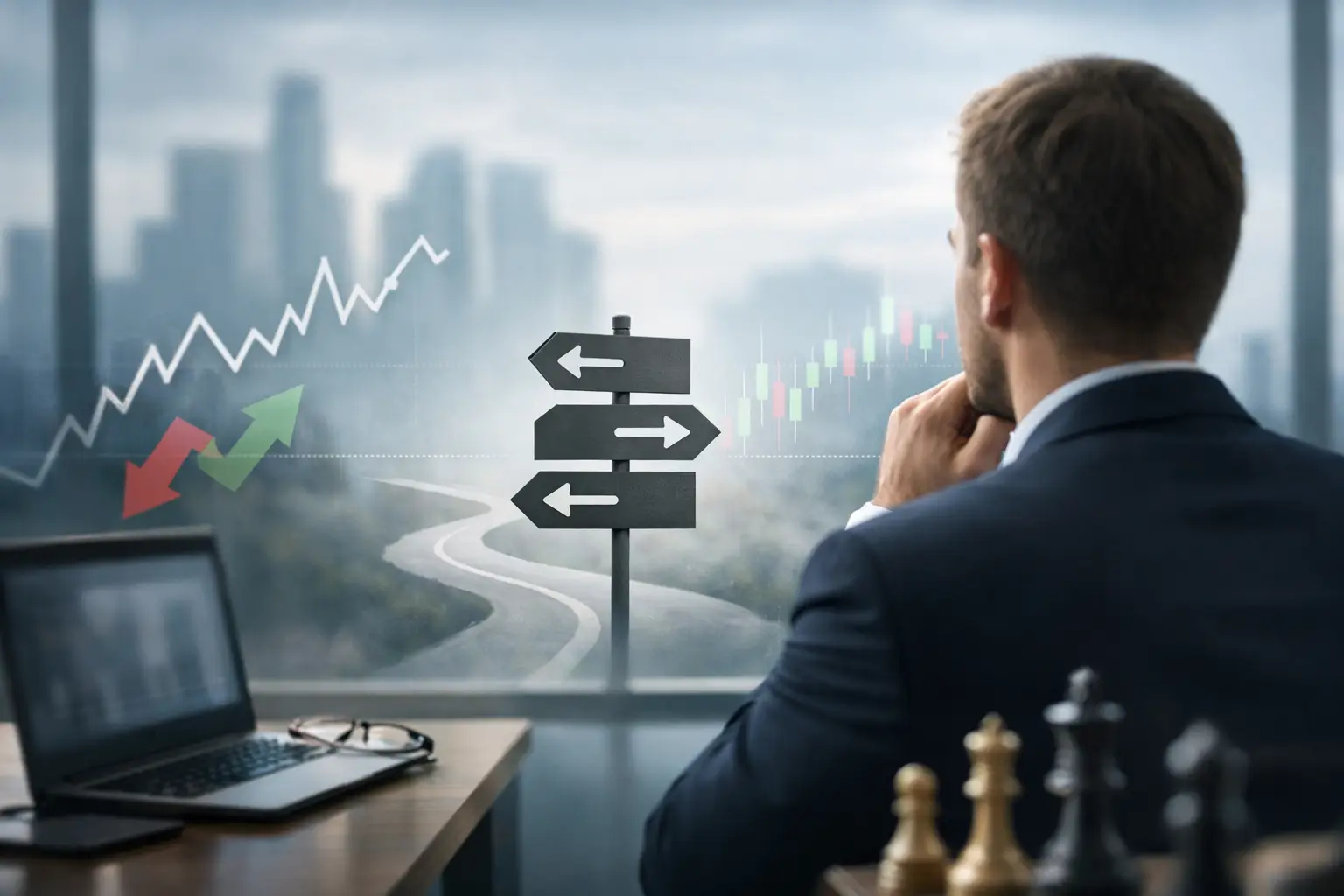
A buyer hesitates for three weeks, watching rates, headlines, and inventory shifts like they might finally reveal the perfect answer. A seller receives a respectable offer, then delays in case a better one appears. An investor sees mixed signals and stays on the sidelines, not because the opportunity is wrong, but because the noise is louder than their own thinking.
This is what decision making in uncertain markets actually looks like. It is rarely a lack of intelligence. More often, it is a surplus of inputs, pressure, and emotion competing for authority.
Uncertain markets do not just test strategy. They test self-trust.
Why decision making in uncertain markets feels so difficult
When the market is stable, people confuse movement with clarity. Comparable sales align. Expectations are easier to set. Timing feels more forgiving. In that environment, even average advice can sound convincing.
Uncertainty removes that illusion. Prices may soften in one segment while holding firm in another. Buyers may have more negotiating power, yet face financing pressure. Sellers may still command strong interest, but only if pricing and presentation are exact. Investors may find opportunity, but with less margin for impulsive thinking.
This is where people start searching for certainty when what they actually need is discernment.
The distinction matters. Certainty says, "I know exactly what will happen." Discernment says, "I understand the variables well enough to make a sound decision anyway."
That is a far more useful standard.
The real risk is not always making the wrong move
Most people assume the greatest danger in an uncertain market is acting too soon. Sometimes it is. But just as often, the greater cost comes from indecision dressed up as caution.
Waiting can be wise. Waiting can also be expensive.
A buyer who delays may protect themselves from overpaying, or they may lose negotiating leverage on a property that fits their long-term life. A seller who holds off may avoid accepting too little, or they may miss the brief window when their home would have stood apart. An investor who preserves capital may be disciplined, or simply paralyzed.
There is no universal rule here. That is why generic market commentary so often fails people. The right move depends on your time horizon, liquidity, tolerance for ambiguity, and the role this asset plays in your broader life or portfolio.
A strong decision is not the one that looks bold from the outside. It is the one that remains coherent when market conditions continue to change.
A better framework for decision making in uncertain markets
In high-stakes real estate decisions, clarity rarely arrives as a feeling first. It is usually built.
The most effective framework begins with three questions.
First, what is objectively true right now? Not what the headlines suggest. Not what a nervous friend predicts. What do current conditions actually show in your price band, asset class, and location? Real estate is intensely local. Broad narratives can be useful context, but poor decision tools when applied without precision.
Second, what matters most in this decision? Speed, price, flexibility, long-term appreciation, lifestyle fit, risk control, tax planning, emotional ease - these priorities are not interchangeable. People get into trouble when they claim to want one thing but negotiate as if they want another.
Third, what would make this decision feel sound six months from now, even if the market moves against you in the short term? That question tends to expose whether you are making a strategic choice or seeking emotional relief.
Sound decisions can still feel uncomfortable. That does not make them wrong.
Clarity is not the same as confidence
This is where many sophisticated clients get stuck. They assume that once the right answer appears, it will feel obvious and calm. Sometimes it does. More often, it feels clean but not easy.
Clarity means the decision aligns with your goals, capacity, and facts on the ground. Confidence is what grows after you have made that decision and can stand behind the reasoning.
In uncertain markets, waiting to feel fully confident before acting often creates a loop of delay. You gather more information, but your standard of certainty keeps moving. You become informed without becoming resolved.
A better approach is to ask whether the decision is sufficiently aligned, sufficiently informed, and sufficiently resilient. If it is, hesitation may no longer be wisdom. It may simply be fear in a more polished form.
The role of emotional intelligence in market decisions
Real estate is often discussed as if it were purely analytical. It never is.
Buying, selling, and investing involve identity, control, timing, memory, family dynamics, and future projection. Brokers know this. Clients feel it. Yet many people still try to make major decisions while pretending emotion is not present.
That usually backfires.
Emotional intelligence does not mean making sentimental choices. It means recognizing the internal forces that may distort judgment. Fear of regret can lead to over-negotiation. Ego can lead to overpricing. Scarcity thinking can create rushed offers on the wrong asset. Fatigue can make mediocre options look acceptable simply because they promise closure.
When these patterns are named clearly, they lose some of their power.
This is one reason a high-level advisor matters in uncertain conditions. The role is not just to present data. It is to help clients think accurately when the stakes are high and the signal is mixed.
What buyers, sellers, and investors each need to remember
For buyers, market uncertainty can create better terms, but only for those who know their ceiling and their non-negotiables. A softer market is not permission to buy casually. It is an opportunity to buy with more selectivity and less emotional competition.
For sellers, the old approach of testing the market with an aspirational price becomes far more dangerous when buyers are cautious. Precision matters. So does positioning. The best result often comes not from chasing the highest possible number, but from creating the strongest possible response from the right pool of buyers.
For investors, uncertain conditions tend to reward discipline. Attractive deals exist, but so do expensive mistakes disguised as bargains. The question is not simply whether the asset is discounted. It is whether the thesis remains sound under tighter assumptions.
Different roles, same principle: the market does not reward urgency alone. It rewards alignment.
How strong advisors think when the market is unstable
Experienced advisors do not promise control over the market. They create control over the decision process.
That means separating trend from noise. It means stress-testing assumptions before a client commits. It means understanding that a negotiation is not only about numbers, but also about timing, leverage, perception, and emotional steadiness.
It also means telling the truth when the answer is to wait.
This is where premium guidance distinguishes itself from transactional service. In uncertain conditions, people do not need more pressure. They need sharper thinking, better questions, and a process that protects both outcomes and peace of mind.
That is the deeper work. And it is often the reason clients make better decisions than they would have made alone.
When to move, when to pause
There are moments to act decisively and moments to step back. The challenge is knowing the difference.
Move when the fundamentals are clear, the decision fits your broader strategy, and the downside is tolerable even if conditions remain imperfect. Pause when the numbers only work under optimistic assumptions, when your priorities are still conflicted, or when you are trying to force a decision to escape discomfort.
The market will always contain uncertainty. What changes is your relationship to it.
When your process is grounded, uncertainty stops feeling like a threat that must be eliminated. It becomes a condition to be managed with intelligence.
That is a more mature standard. It is also a more profitable one.
Shanna Giannakis approaches real estate through that lens - not as a transaction to push through, but as a decision to refine until it is both strategic and deeply aligned.
The goal is not to predict every turn in the market. The goal is to become the kind of decision-maker who can move well within it.